
Introducing Ānśik ID
A dynamic, partial identity platform that eliminates reuse, replay, and static identifier exposure.
Designed for government ID, payments, and enterprise access systems.
Ānśik ID™
A fundamental challenge across modern identity systems is the reliance on static personally identifiable information (PII) — such as identity numbers, usernames, expiry dates, and security codes — that remains unchanged across repeated use. Once exposed, static identifiers can be reused, replayed, and exploited across services and channels.
Ānśik ID™ addresses this problem by replacing static identifiers with dynamic, partial identity values that are valid only for a limited time and context, significantly reducing the risk associated with interception, reuse, or compromise.
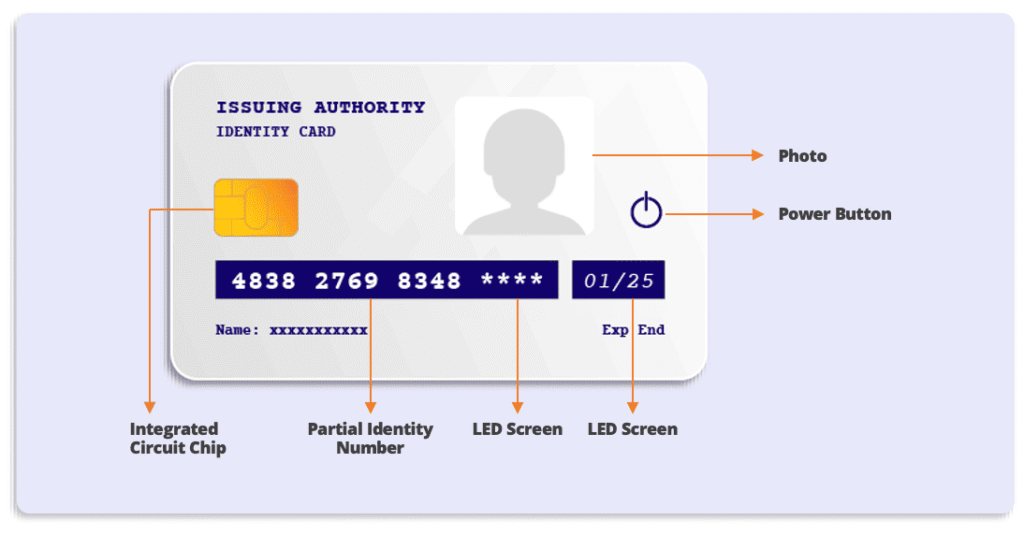
Only partial, expiring identity values are shown on the ID card, reducing exposure if observed or copied.
How Ānśik ID™ Works
Rather than displaying or transmitting a complete identity, Ānśik ID™ exposes only a partial identity value to the user or relying party. The complete identity is never directly shared and can be reconstructed only by an authorised Identity Provider under controlled policy conditions.
Each relying party is mapped to a unique, context-bound complete identity, ensuring that identity values cannot be reused or misapplied across different services. Identity values automatically expire and regenerate, preventing replay, enumeration, and credential harvesting attacks.
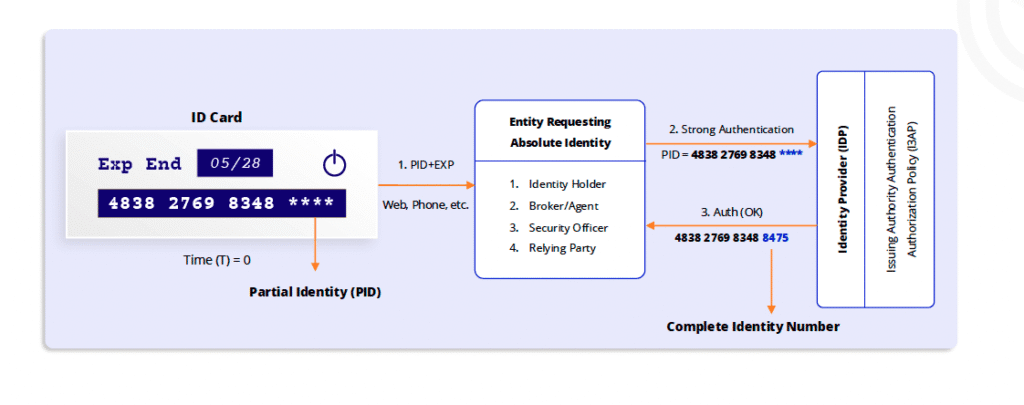
Complete identity is never exposed. It is reconstructed securely by the Identity Provider only after policy-driven authentication.
Dynamic Protection by Design
Ānśik ID™ introduces renewable identity behaviour across both physical and digital environments. Identity values rotate based on policy-defined intervals, assurance level, or usage context, ensuring that previously observed identifiers become unusable outside their valid window.
For online environments, Ānśik ID™ supports dynamic usernames (One-Time Usernames) and renewable authentication credentials, eliminating static usernames as a common attack vector and strengthening existing authentication frameworks without requiring end-user retraining.
Where It Can Be Deployed
Ānśik ID™ is designed to operate across a wide range of identity ecosystems, including:
- Government and national identity programs.
- Payment cards and financial authentication systems.
- Enterprise access, workforce credentials, and online identities.
- Digital identity wallets and regulated authentication platforms.
The system supports both software-based smart cards (mobile applications) and hardware smart cards, with full feature parity across both formats.
Key Advantages
1. Mitigates a broad range of identity-based attacks, including phishing, skimming, replay, MITM, and insider misuse.
2. Dynamic expiry ensures time-bound validity of identity values.
3 Static PII is never reused; complete identities regenerate automatically using One-Time Complete Identities (OTCI).
4. Unique identity mapping per relying party prevents cross-service misuse.
5. Broad-spectrum protection across physical and digital identity channels.
6. Compatible with government IDs, payment cards, and online identity systems.
7. Non-invasive deployment, requiring no behavioural change or user training.
8. Eliminates static usernames through One-Time Usernames (OTUN).
9. Reduces operational and logistical costs for issuers, verifiers, and service providers.
Why It Matters
By limiting identifier exposure to renewable, partial values and centralising reconstruction within trusted systems, Ānśik ID™ shifts identity security from detection and recovery to prevention by design.
When deployed at scale, it enables a fundamentally safer model for issuing, using, and verifying identities across modern digital and physical infrastructures.
Ānśik ID™ aligns with higher assurance identity frameworks, including the Zero Identifier Exposure Layer (ZIEL™) and Programmable Identifier Assurance Levels (PIAL™).
Ānśik ID™ is based on a patented Dynamic Partial Identity (DPID) Architecture.
Ānśik ID™ – Software Smart Card
Software-based smart cards provide a highly scalable and cost-efficient deployment model for Dynamic Partial Identity.
In this approach, device-bound cryptographic material is securely stored within a mobile application. The application interacts with the authorised Identity Provider to generate renewable, partial identity values in accordance with the required Programmable Identifier Assurance Level (PIAL™).
The complete identity is never stored or exposed on the device and can be reconstructed only by the authorised Identity Provider under controlled policy conditions. Even if a device is compromised, exposed identity fragments cannot be reused outside their intended context or validity window.
Key Benefits
- Cost-efficient and scalable — no dedicated hardware required.
- Rapid provisioning — identities can be issued and updated instantly.
- No physical logistics — eliminates card printing, shipping, and lifecycle overhead.
- Context-bound identity — identity fragments are valid only within approved usage conditions.
Aligned with PIAL™ policies — identity validity, exposure limits, and assurance levels can be dynamically enforced.
Ānśik ID™ Software Smart Card delivers full Dynamic Partial Identity functionality using secure mobile environments, making it suitable for large-scale consumer, enterprise, and government deployments.
Ānśik ID™ — Hardware Smart Card
Hardware-based smart cards provide a high-assurance deployment option for Dynamic Partial Identity, designed for regulated and security-sensitive environments.
In this model, device-resident cryptographic material is securely stored within certified hardware (such as FIPS or Common Criteria evaluated smart cards). The card generates renewable, partial identity values in coordination with the authorised Identity Provider and in accordance with the required Programmable Identifier Assurance Level (PIAL™).
As with all Ānśik ID™ deployments, complete identities are never exposed by the card. Identity fragments are context-bound, time-limited, and unusable outside their authorised conditions, ensuring that even physical compromise does not result in reusable credentials.
Additional Advantages
- Higher assurance environments — suitable for government, critical infrastructure, and regulated sectors.
- Isolation from mobile OS risks — hardware execution reduces exposure to device-level malware and zero-day exploits.
- No smartphone dependency — supports secure authentication in restricted, controlled, or offline settings.
- Tamper-resistant design — protects cryptographic material against physical and side-channel attacks.
- Aligned with PIAL™ policies — identity validity duration and exposure limits can be enforced at the required assurance level.
Ānśik ID™ Hardware Smart Card delivers full Dynamic Partial Identity functionality with the strongest level of device and environmental assurance.